
The entire process of hybridoma has a certain degree of complexity and skill. For example, in the process of immunizing animals, adjuvants are usually used when injecting antigens to avoid non-specific immune reactions that rapidly decompose antigens, achieve slow antigen release and act on the immune system, and ultimately improve the efficiency of producing antibodies with high affinity; For example, as the most crucial step in the preparation of monoclonal antibodies, the cell fusion rate directly affects the preparation of antibodies, especially for the treatment of mouse spleen, which needs to be very careful. A slight negligence can affect the final fusion efficiency.
Hybridoma technology can ensure that the quality of antibodies prepared in different batches is the same and easier to replicate, making it an efficient antibody preparation technique. The technical process for obtaining monoclonal antibodies through hybridoma technology is roughly as follows:
Immunization of Mouse
The process begins with the immunization of a mouse with antigen studied. It stimulates the animal’s immune system to produce a variety of antibodies against the antigen.[1]
Isolation of B cells from the spleen
Spleen cells from the immunized mouse, which contain B lymphocytes producing the antibodies, are harvested.
Cultivation of myeloma cells
Fusion of myeloma and B cells
These cells are then fused with myeloma cells (cancerous B cells) that can grow indefinitely in culture. The fusion is typically facilitated using polyethylene glycol (PEG) or electrical fusion.
Separation of cell lines
The resulting hybrid cells (hybridomas) are cultured in a selective medium, usually hypoxanthine-aminopterin-thymidine (HAT) medium. Only the hybridomas can survive in this medium because they possess the necessary enzyme machinery from the spleen cells to bypass the metabolic block induced by aminopterin.[1]
Screening of suitable cell lines
Hybridomas are screened for the production of the antibody, typically using assays such as ELISA (enzyme-linked immunosorbent assay). Positive clones are then isolated[1].
In vitro (a) or in vivo (b) multiplication
Obtaining a large amount of monoclonal antibodies through in vitro culture or in vivo induction.
Production and Purification
Once a stable hybridoma producing the desired monoclonal antibody is obtained, it can be cultured in large quantities. The monoclonal antibodies are then harvested from the culture medium and purified using techniques like protein A/G affinity chromatography.
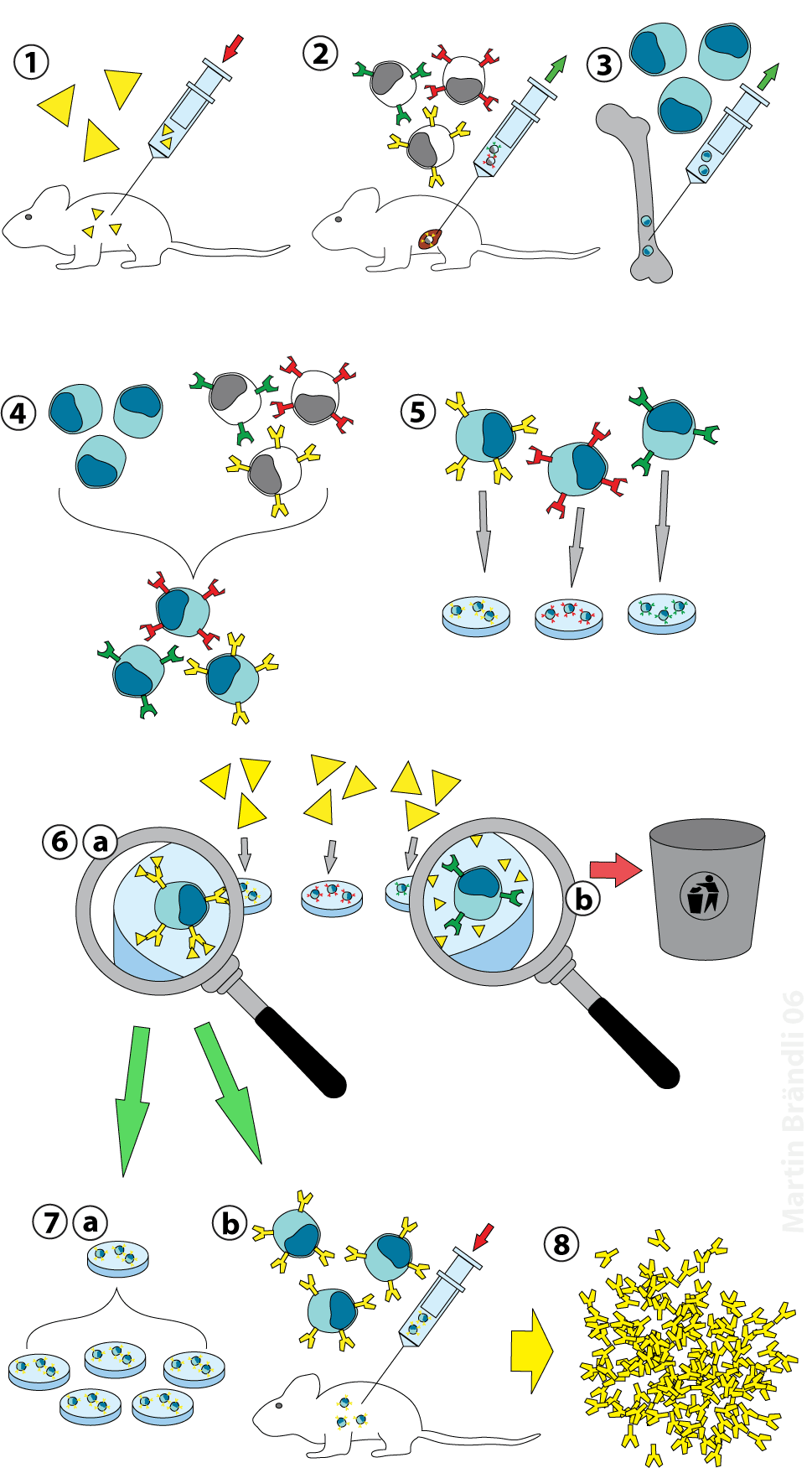
Figure 1: (1) Immunization of a mouse (2) Isolation of B cells from the spleen (3) Cultivation of myeloma cells (4) Fusion of myeloma and B cells (5) Separation of cell lines (6) Screening of suitable cell lines (7) in vitro (a) or in vivo (b) multiplication (8) Harvesting (Figure Source: Wikipedia)
Advantages of Hybridoma Technology
Specificity and Uniformity
Monoclonal antibodies produced by hybridomas are highly specific to a single epitope of the antigen, ensuring uniformity in their action. This specificity is crucial for diagnostic and therapeutic applications.
Unlimited Supply
Hybridoma cells can be cultured indefinitely, providing a consistent and renewable source of monoclonal antibodies.
Customizability
The technology allows for the customization of antibodies to target specific antigens, which is invaluable in research, diagnostics, and treatment of diseases such as cancer and autoimmune disorders.
Applications of Hybridoma Technology
Therapeutics
Monoclonal antibodies are used in the treatment of various diseases, including cancers (e.g., Rituximab for non-Hodgkin lymphoma), autoimmune diseases (e.g., Infliximab for rheumatoid arthritis), and infectious diseases.
Diagnostics
Monoclonal antibodies are essential in diagnostic tests, such as home pregnancy tests and various ELISA-based assays, due to their high specificity.
Research
In research, monoclonal antibodies are used to detect or quantify specific proteins, study cell signaling pathways, and investigate immune responses.
Reference
[1] Parray HA, Shukla S, Samal S, et al. Hybridoma technology a is versatile method for the isolation of monoclonal antibodies, its applicability across species, limitations, advancement, and future perspectives. Int Immunopharmacol. 2020;85:106639. doi:10.1016/j.intimp.2020.106639